Bulletins From the Front #15
“Bibles laid open, millions of surprises” [1]

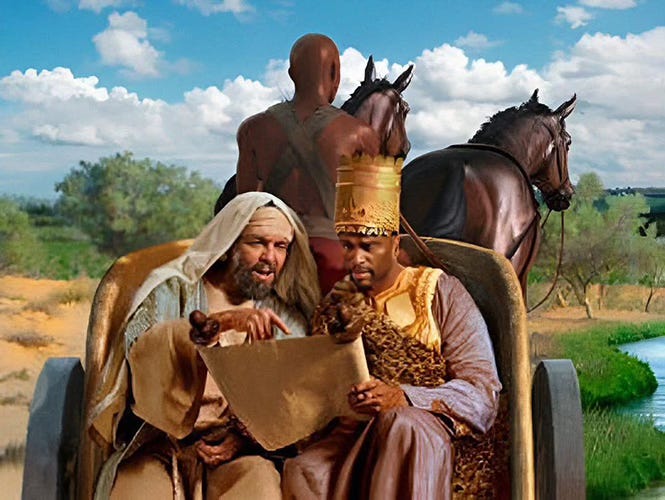
As for Philip, an angel of the Lord said to him, “Go south down the desert road that runs from Jerusalem to Gaza.”
Christians need to be told where to go and when to go, because we already know what to do when we get there: preach the Good News! There seemed to be little confusion among the thousands of new disciples who got run out of Jerusalem by the authorities. “But the believers who were scattered preached the Good News about Jesus wherever they went.” [2]
Scattered is a different word from sent. Trouble has scattered millions, and they have become refugees. When followers of Christ are scattered, they are transformed into the Sent. [3] They are equipped with a divine guidance system. Angels showed them the way, and the Holy Spirit reminded them of everything Jesus taught through the Apostles’ teaching. They weren’t wandering like their ancestors through the wilderness, a collective, a throng, guided by a cloud by day and a pillar of fire by night. The children of Israel waited while their leader talked to God and got further instructions, then criticized and organized a mutiny against him. [4]
The scattered individuals had a personal mission, a responsibility. It was no longer only in the hands of the Apostles and Prophets; every person in whom God now resided was a temple, a priest, and a preacher.[5] They all had a story to tell as a “witness.” Some, however, were chosen for special assignments; Philip was one of those to the extent that he became famous. Luke, the Physician/Historian, made him so by recounting his experience on the road from Jerusalem to Gaza. That road in 2026 is Route 383, which is now war-torn, disputed, guarded, and closed to the public. In the first century, it was wide enough for a horse or chariot.
The curious eunuch
Philip came upon a black man from Ethiopia, whom Luke identified as the Treasurer of Ethiopia. He served under the Kandake, the Queen of Ethiopia. He had been in Jerusalem worshipping; it is assumed that he had some interest in monotheism. A belief in one God who was creator and sovereign over all the world was not a common feature of the first-century world. It was still largely a pagan world of local or regional gods. There was some seepage from the classic Greco-Roman world filled with its mythology, pagan temples, and pantheon of gods. The Greek gods were not holy; they were at best temperamental, capricious, jealous of one another, and very competitive. Please know: gods need to be real to be anything as described above. And since they were not and are not real, they are not the things people imagined, because they were projections of themselves—not worthy of our worship.
Did I mention he was a eunuch? This is important for historical accuracy. Eunuchs were castrated for several reasons. It made a man a more temperate personality, not given to certain ambitions for power and for sexual trysts. Since this gentleman was the Chief Financial Officer of the Ethiopian Kingdom and had influence with the Queen, it eliminated much that could go wrong. Dare I posit this would not have been a bad idea for some United States Presidents? Think of all the time saved on scandals, divorces, and court costs. A few candidates might pause to reflect before entering a primary. It certainly would liven up the inaugural festivities.
The eunuch was under escort, reading in his carriage. He had a nice ride with an excellent suspension because he was level enough to read on an unpaved road. He was reading the scroll of Isaiah. Owning such a scroll was rare. Few people could have afforded to purchase such a valuable document, and he was reading aloud, which indicated he was fluent in Hebrew. It was obvious he was an important person, wealthy, and highly educated.
Philip could have been walking, and why not? He had gotten there on his own, but would be transported out by the Angel. Under such tutelage, who needs a horse, chariot, or carriage? He seems to have kept his distance, but near enough to hear the official’s reading. The Holy Spirit told Philip what to do. This again reveals that God places us in special moments and nudges us to take action. Philip could have been intimidated by the carriage, the entire persona of the well-dressed and finely appointed official, with a driver and guards.
Yet, he trotted over to the moving carriage and, in a rather comical scene, asked the man, “Do you understand what you are reading?” The eunuch responded with candor, “How can I unless someone instructs me?”
Self-reliance
This reminds me of a common error made by contemporary believers. The Reformation led to unintended consequences of individualism. About 160 years after the Reformation began, the church became aware that what had happened should be called something, and so they called it the Reformation. It is celebrated in many Christian circles and rightly so. But the underbelly of it has been the splintering of the church and the individualization of biblical interpretation. This is problematic when the average Bible reader attempts to understand the Bible without any guidance from those who have gone before them. There is nothing quite as dangerous as an untutored zealot, fully confident they understand the Bible and, with hubris, tell everyone how their forefathers got it wrong, but they have it right. Ironically, this is how the Pharisees saw Jesus. But the off-the-wall biblical exegetes don’t walk on water, turn water into wine, and rise from the dead. Therefore, it might be wise to put Jesus into his own category.
The believer priest, I-report-to-Jesus-only, mania running unabated in the 20th and now 21st century, has led to many malformed and uninformed souls. The Bible is a book of great mystery, but it tells a very clear story if you read it with some help lifting the veils of time, language, culture, and context. Such assistance can open fresh new vistas of spiritual truth and insight. The Eunuch was diligent, earnest, and open. He was also at a loss to interpret the scroll of Isaiah. It was the classic Messianic passage concerning Christ as the suffering servant. He knew it meant more than was apparent, and with the help of Philip, he was able to see it more clearly. It was the difference between interesting and life-changing.
“He was led like a sheep to the slaughter. And as a lamb is silent before the shearers, he did not open his mouth. He was humiliated and received no justice. Who can speak of his descendants? For his life was taken from the earth.” [6]
Questions
The man asked Philip who Isaiah was talking about. Philip began by explaining that Jesus was the person promised by God through Isaiah, and then told what had happened in Jerusalem several years before. It was all Good News. Just then, they came upon some water, and the Eunuch became excited, “Look! There’s some water! Why can’t I be baptized?” Some other Greek texts add Philip answering, “You can if you believe with all your heart,” and the Eunuch answered, “I believe that Jesus Christ is the son of God.” I am skeptical that this addition is genuine; it sounds a bit contrived and added by a committee, like a recital piece memorized for a special occasion.
It seems much more likely that the Eunuch ordered the carriage to stop, and Philip immediately baptized him. When they came up out of the water, Philip was snatched away, the Eunuch was left standing alone, soaked, and if not for the water dripping off his body, might have asked himself if the entire episode really happened. As the Eunuch went on his way with his entourage, he was rejoicing. They never saw each other again, but he knew Philip was real, and he was made new. Philip, on the other hand, was even more flabbergasted; he wasn’t used to being transported like an angel from one site to another. I must say I would be quite open to such travel; I might want to do more of it. But regardless of where he went and how he got there, he knew what to do when he got there. He knew because he was taught, trained, and commissioned through the laying on of hands by the Apostles.
“He preached the Good News there and in every town along the way until he came to Caesarea.”
If only
One could get the wrong idea from this story. You might conclude that you could do such spectacular things if you had been commissioned by the very hands of the Apostles. You might even scoff, “Who couldn’t with those credentials?” For the record, Philip’s sendoff wasn’t run of the mill; it was recorded in Holy Writ, and it made him world famous. [7] There are paintings, sculptures, writings, and many churches and religious orders named after him. He was special, because he was one of the first to spread the gospel to other countries. One of the facts of history was the growth of the early church in Ethiopia based on this event with the Eunuch.
This historical fact and the events that followed do not get you and me off the hook. “Off the hook,” means we are excused from the same responsibility to be a witness for Christ wherever we go. It didn’t even get Philip off the hook. You might think after such a success, Philip would say, “Hey Lord, I’ve just reached a new kingdom and country of Ethiopia, then East Africa, could I go home now?” Philip has done his thing; he could retire to his monastery. Certainly, he would be upgraded from a Deacon to a Lieutenant Apostle. Come on, he’s done his bit.
Retirement
Nope, he’s just on a different road to a new Roman city, Caesarea, named after both the Roman god, Julius Caesar, and the son of god the adopted son, Caesar Augustus. His face was on the coins and every city had a statue to honor him. This was the god every Roman citizen would be obliged to bow before—and every Christian was obliged not to bow before. It was a gentile city with a small Jewish community. The dominant story was of a god who reigned and a glorious son who sat at his right hand in the heavens. Julius Caesar and his son, Augustus. It was this city that Philip would walk into with a different story of a Jewish God and his son. This would show that Caesar was not God, but that a Jewish woodworker turned miracle worker was God. Philip walked into that city and he knew what he was to do when he got there; he didn’t even need to ask. It was to preach the Good News. History recalls that Philip set up a home in the city and lived there for twenty years.
So, followers of Jesus, just move into the cities and start living, start talking, witnessing, and preaching. Because you have many ancestral hands on your head, commissioning you. Just keep it up until you get transported.
From the Belly of the Beast
Bill Hull 2026
[1] George Heibert. The Canterbury Poets, Edited by William Sharp.
[2] Acts 8:4
[3] Acts 1:8
[4] Of course, I am speaking of the sojourners in the wilderness and their on-again, off-again, love-hate relationship with Moses.
[5] Matthew 28:18-20, I Corinthians 6:19,20, I Peter 2:5-9
[6] Acts 8:32,33 from Isaiah 53:7,8